DWIH Network Day
Events
Upcoming Events

SALON: LECTURE
Ahmet Yikik & Aylin Walder
»Elif Shafak. A Sociological Exploration of Gender and Migration.«
2 July 2025 - 6 p.m., International House (Kringsweg 6)
The venue is wheelchair accessible and the lecture will be held in spoken English.

The work of Elif Shafak, a British author of Turkish descent, delves deeply into migration and gender issues. In this presentation, I will shed light on so-called "deviant" individuals and social groups through Elif Shafak's narrative landscape. I will discuss how Shafak’s fiction contributes to expanding the concept of being "human" by addressing issues of gender and migration. In essence, I aim to lay the groundwork for re-imagining social concepts through literary works.
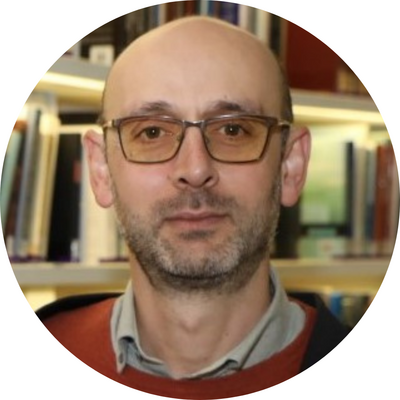
Ahmet Yıkık
Ahmet Yıkık obtained both his master’s degree (2013) and his PhD (2019) from the University of Cyprus, Department of Turkish and Middle Eastern Studies where he currently serves as an Assistant Professor. Yıkık is the author of two books: *Voices from the Periphery – Written Works from Cyprus* (Kesit Publications, Istanbul, 2022, in Turkish) and *First Serialized Novel in Turkish Cypriot Literature: A Glance* (Günce Publications, Ankara, 2021, in Turkish). In addition, he continues to contribute to Cypriot literature through criticism and translation. His research interests include immigration, social mobility, identity, gender, and prejudice.
University of Cologne International Events Calendar
-
-
UoC International Liaison Offices Week 2025
July 14th - 18th, 2025 | Cologne Every year for one week the Executive Directors of all five UoC international…
-
UoC International Liaison Offices Week, Contact New York Office
July 14th - 18th, 2025 | Cologne Every year for one week the Executive Directors of all five UoC international…
-
Exclusive Alumni Networking Reception with University of Cologne Rector and DAAD President Prof. Dr. Joybrato Mukherjee
August 26th, 6-8 PM (EST) | New York, New York Join us for a networking reception co-hosted with our close partners…
-
German Universities Alumni Evening - Uni & US
August 28th, 8 PM (EST) | Location: Boston, Massachusetts Together with our partners from University of Heidelberg,…
-
Annual GAIN Conference and Talent Fair 2025
August 29th-31st | Boston, Massachusetts The German Academic International Network (GAIN) is the network of…
-
PostDoc Fair - Make Germany Part of Your Research Career!
September 2nd | New York, New York Alongside other representatives from German universities, funding and exchange…
-
DWIH New York Future Forum 2025
September 8th | Broad Institute, Boston, Massachusetts Hosted by the German Center for Research and Innovation (DWIH)…
-
Steuben Parade with the Consulate General of Germany, NYC
September 20th, 12 PM (EST) | 5th Avenue, New York, New York The Steuben Parade celebrates German, Austrian, and…
-
GAIN 25 Digital Event Including University of Cologne Workshop
September 25th, 12-1:15 PM (EST) | Online For all those who cannot make it to this year's GAIN conference in Boston,…
Past Events
In Cooperation with the Institute for International Criminal Law SPECIAL Event
SPECIAL Event
Caroline Bettinger-Lopez
»Law Clinics, Universities, and Liberal Thought - Finding Clarity in a Time of Chaos and Cacophony«
16 June 2025 - 6 p.m., International House (Kringsweg 6)
The venue is wheelchair accessible and the lecture will be held in spoken English.
We are living through a time of far-reaching legal, political, and social upheaval that is challenging both the integrity and staying power of the international rules-based order and democracy itself. In the United States, and increasingly in other democratic nations, a concerted and relentless onslaught of orders, policies, and laws at all levels of government threaten communities, institutions, and individuals, shrinking so-called “safe spaces” and creating unprecedented and unanticipated fault lines. This conversation will explore how law clinics (both faculty and students), universities, and our broader communities can serve as defenders of justice and sustain our work and purpose during this critical time, and amid the chaos.
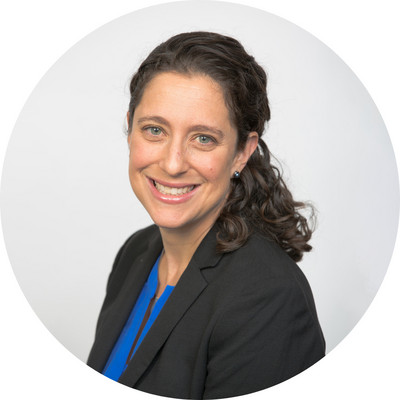
Caroline Bettinger-Lopez is Professor of Law, Faculty Chair of the Human Rights Program, and Director of the Human Rights Clinic at University of Miami School of Law Former Senior Advisor on Gender & Equality, U.S. Department of Justice and The White House, Gender Policy Council Caroline Bettinger-López is a Professor of Law, Faculty Chair of the Human Rights Program, and Director of the Human Rights Clinic at University of Miami School of Law, which she founded in 2010.
From 2021-2024, she served as a Senior Advisor at the U.S. Department of Justice and the White House Gender Policy Council. From 2015-2017, she served in the Obama-Biden Administration as the White House Advisor on Violence Against Women and Senior Advisor to Vice President Joe Biden.
Professor Bettinger-López focuses on gender-based violence, racial justice, and immigrants’ rights in domestic and international forums. She previously taught at University of Chicago School of Law and Columbia Law School, and worked at the Council on Foreign Relations, ACLU Women’s Rights Project, and as a federal law clerk. She is a Commissioner on the Lancet Commission on Gender-Based Violence and Maltreatment of Young People and a recipient of a Roddenberry Fellowship and a TIME’S UP Legal Defense Fund grant.
Please register by emailing at internationales-strafrecht@uni-koeln.de
SALON: DISCUSSION
Julie Smith & Birgit Bujard
»The Changing International Order and the Renewed Momentum to Unite Europe«
17 June 2025 - 6 p.m., International House (Kringsweg 6)
The venue is wheelchair accessible and the lecture will be held in spoken English.
Global and regional events over the past three years have conspired to bring Europeans closer together. Russia’s illegal war in Ukraine since 2022 has led to European solidarity with its democratic neighbour, including allowing Ukraine to begin the road to European Union membership. Meanwhile, two European states, Sweden and Finland, finally dropped their neutrality and joined the North Atlantic Treaty Organization. The re-election of Donald Trump in 2024 has caused chaos in the financial markets and a possible trade war, again leading to strong European responses. The US President’s ambivalence about NATO has further provoked European reactions. Defence cooperation, including with the United Kingdom, is firmly on the agenda.
This lecture will argue that decisions in Washington and Moscow have acted as catalysts for closer cooperation among European countries, precisely the opposite of the disruption they sought to achieve.

Julie Smith
Professor Julie Smith (Baroness Smith of Newnham) is Professor of European Politics at Cambridge University, Fellow of Robinson College, Cambridge and a member of the House of Lords, the upper chamber of the British Parliament. Julie’s research interests centre on the history and politics of the European Union, democracy in Europe and the UK’s relations with the EU, with particular interests in defence. Her publications include The Palgrave Handbook of the 2024 European Parliament Elections, co-editor and contributor (Palgrave, forthcoming 2025), a Special Issue of German Politics on German-Turkish-EU relations (forthcoming 2025), The UK’s Journeys into and out of the EU – Destinations Unknown (Routledge, 2017) and The Palgrave Handbook of European Referendums (editor and contributor Palgrave, 2021).
SALON: LECTURE
Mohammed Errbii & Luisa María Jaimes Nino
»The Fascinating World of Ants: The Little Things That Run Our Planet«
6 June 2025 - 6 p.m., International House (Kringsweg 6)
The venue is wheelchair accessible and the lecture will be held in spoken English.
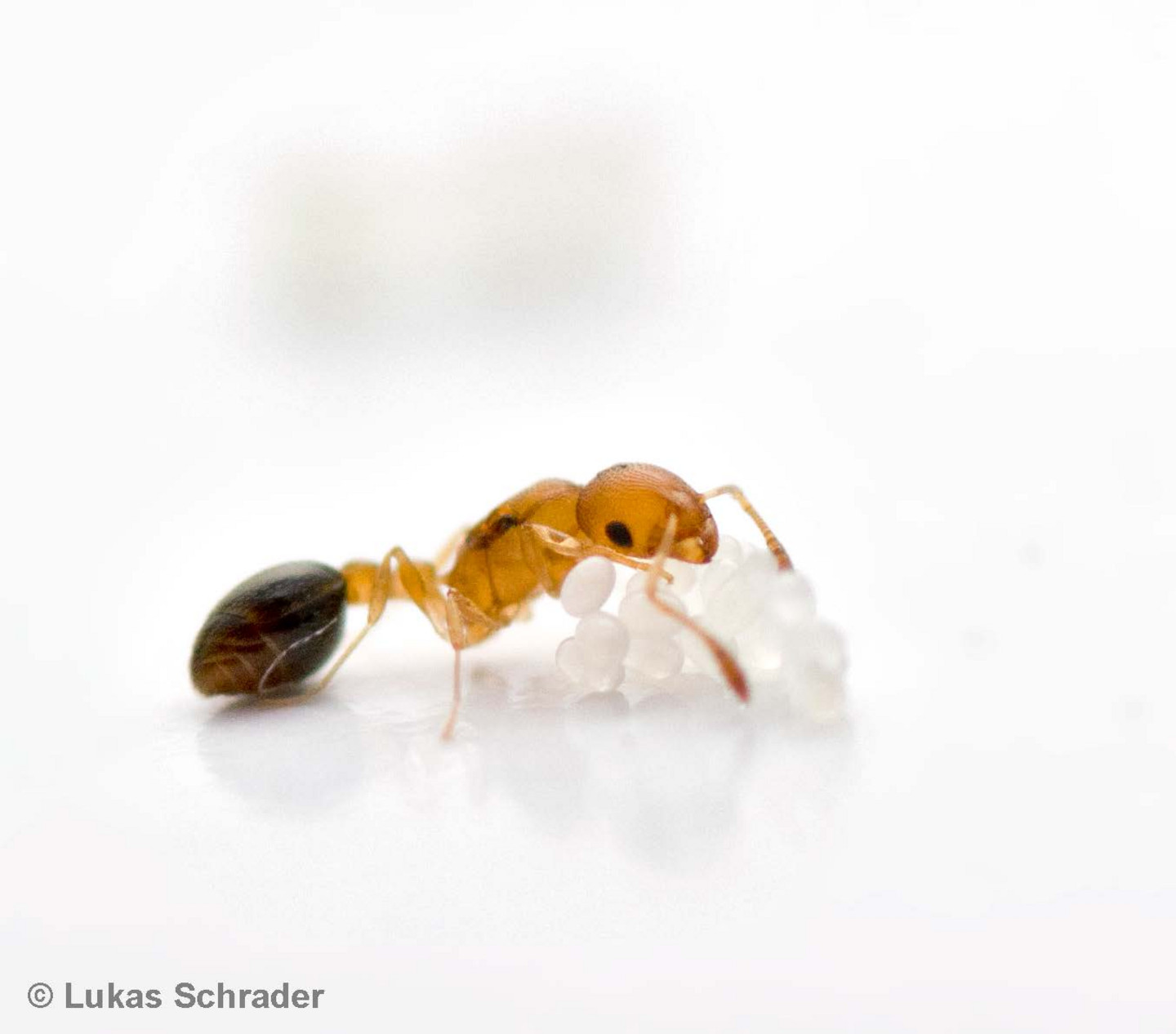
With over 15,000 extant species and at least 150 million years of evolutionary history, ants are among the most successful multicellular lineages on our planet. Today, their total biomass exceeds that of all mammals combined, making them one of the dominant organisms in terrestrial ecosystems.
Together with a colleague from Mainz University, we will share our fascination with ants. In an informal setting, we will present some of the most remarkable studies on ants, showcasing how their adaptive innovations and functional diversity have been key to their success. Additionally, we will share insights from our own research on Cardiocondyla obscurior, an emerging model organism for studying social evolution, genome evolution, aging, and developmental processes.
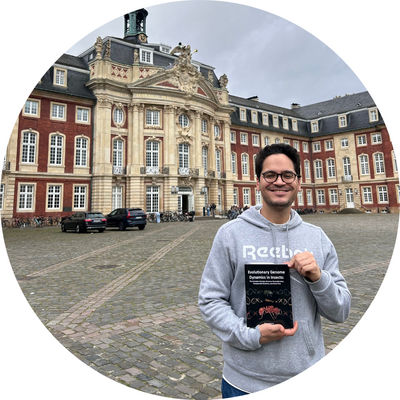
Mohammed Errbii
Mohammed “Simo” Errbii is a biologist from Morocco specializing in evolutionary genomics. He recently completed his Ph.D. in Biology at the University of Münster, Germany, where he investigated genome dynamics and evolution in insects. His research focuses on how genetic diversity is generated and its impact on organisms, using population and comparative genomics approaches, with a special focus on ants. Currently, he is a postdoctoral researcher at the University of Cologne, investigating genome dynamics in asexual organisms to better understand the evolutionary significance of sexual reproduction.

In Cooperation with AmerikaHaus NRWSPECIAL Event
SPECIAL Event
Kimberly Wehle & Kirk Junker
»What is a Constitutional Crisis?«
22 May 2025 - 6.30 p.m., Hörsaal XII (UoC Main Building, Albertus-Magnus-Platz)
The lecture and discussion will be in spoken English.

The return of Donald Trump to the White House has reignited debates over the balance of power among the executive, legislative, and judicial branches,
and raised pressing questions about the strength and resilience of American democratic institutions in a time of political transformation. As the current
administration moves swiftly to implement its agenda, reshape the federal bureaucracy, and challenge long-standing interpretations of executive
authority, legal scholars and observers are grappling with urgent questions: Where are the boundaries of presidential power? What role must the other
branches play in maintaining constitutional equilibrium? When do institutional tensions signal a true constitutional crisis—and what exactly
defines such a crisis in a system built to endure conflict and disagreement? These are no longer theoretical concerns—they are the defining constitutional challenges of 2025.
This joint event with AmerikaHaus NRW will explore what it means to face a constitutional crisis today, unpacking the shifting dynamics between the branches of government, the evolving role of the courts, and the broader implications for civil liberties and the future of American democracy.
Join us for a vital conversation about the U.S. Constitution with:

Prof. Dr. Kimberly Wehle, University of Baltimore
Kimberly Wehle is an expert in constitutional law and the separation of powers, with particular emphasis on presidential power and administrative agencies. She is a tenured law professor at the University of Baltimore School of Law, where she teaches Constitutional Law, Civil Procedure, Administrative law, and Federal Courts. She is currently a Fulbright Scholar in the Netherlands where she is also the inaugural Resident Thinker at The John Adams Institute. Further, Wehle is also a legal contributor for ABC News and regularly writes for Politico, The Atlantic, and The Bulwark. Winner of the University of Maryland System Board of Regents Award for excellence in scholarship. Wehle also writes and comments on the Supreme Court, election law and voting rights. She was an Assistant United States Attorney in the Washington D.C. office and Associate Independent Counsel in the Whitewater Investigation. She is the author of several books, including How to Read The Constitution—and Why, and How to Think Like a Lawyer— and Why and Pardon Power: How the Pardon System
Works—and Why.

Prof. Dr. Kirk Junker, University of Cologne
Kirk Junker, a native of Pittsburgh, studied law in both Germany and the United States, receiving his law degree from Duquesne University. He is a member of the Pennsylvania Bar and was a public environmental law prosecutor for the Pennsylvania Department of Environmental Resources for ten years before obtaining his PhD in ancient rhetoric. Professor Dr. Junker is author or co-author of 9 books, including the Introduction to US Legal Culture, available in English, German and Italian, 49 book chapters, and 56 articles on environmental law, comparative and international law and ethics. He is a frequent guest on German, Swiss and Luxembourg media. Professor Junker has held professorships on faculties of law in the United States and Germany, in communication in Dublin (Ireland) and Belfast (Northern Ireland), and in natural science in the UK. For the last 15 years, Prof. Junker has held the Chair in US Law at the University of Cologne. He is currently also the Vice Rector for Sustainability at the University of Cologne.

Perspectives: LECTURE
Housamedden Darwish
»The Concept of Heritage in Contemporary Arab Thought«
19 May 2025 - 4 p.m., International House (Kringsweg 6)
The venue is wheelchair accessible and the lecture will be held in spoken English.
Heritage occupies a central place in contemporary Arab culture and Arab thought. To explore this, I will address the conceptual significance of heritage, its meanings, and its entanglement with other key ideas, such as tradition, the past, authenticity, modernity and renaissance. In doing so, I will also reflect on how Arab intellectuals have approached heritage as both a cultural foundation and a contested problem. By examining the engagement of Arab thought with heritage over time, the shift from revivalist to critical and then to synthesis-oriented perspectives is highlighted. This evolving debate is further situated within the broader intellectual and political challenges in the Arab world. To illustrate these approaches, the works of Hussein Muruwa, Tayeb Tizini, Sadiq Jalal al-Azm, Muhammad Arkoun, Abdullah Laroui, Hassan Hanafi, Muhammad Abed al-Jabri, and Radwan al-Sayyid are underlined as representative models of distinct approaches to heritage in contemporary Arab discourse.
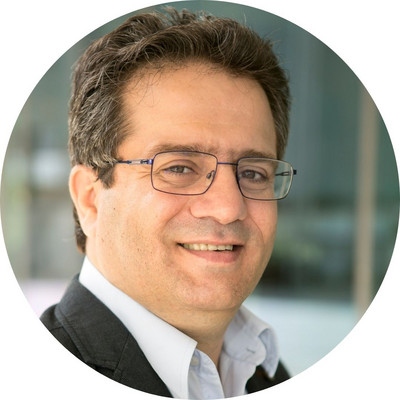
Housamedden Darwish is a writer, researcher, and lecturer at the University of Cologne. He earned his PhD in Philosophy with a specialization in Hermeneutics from the University of Bordeaux 3, awarded summa cum laude with distinction. His work engages with philosophy, Arab thought, Islamic studies, and cultural studies. He has authored nine books in Arabic and three in French and published widely in peer-reviewed journals and in translation in both Arabic and English.
SALON: LECTURE
Rotem Gross
»Antibiotics and Bacteria: A Battle for Survival«
21 May 2025 - 6 p.m., International House (Kringsweg 6)
The venue is wheelchair accessible and the lecture will be held in spoken English.
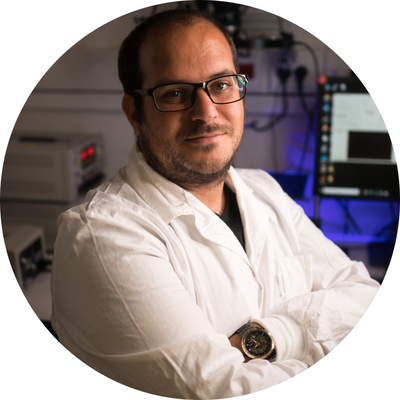
Antibiotics have transformed medicine by turning deadly infections into treatable conditions, saving countless lives.
In this discussion, we will explore what antibiotics are, how they specifically target and disrupt bacterial cells, and the biological mechanisms that make them effective. However, bacteria have evolved techniques to neutralize antibiotics, including modifying their processes to prevent drug action and producing neutralizing enzymes. We will examine how bacteria acquire resistance features through random mutations and gene sharing across species. Understanding the function of antibiotics and bacterial resistance is essential for addressing the challenge of antibiotic resistance.
This talk will provide an overview of this complex struggle and its implications for human health.
Video by I Contain Multitudes to illustrate the topic of antimicrobial resistance
SALON: DISCUSSION
Anan Alsheikh Haidar & Claus Kreß & Isabel Schayani
»Syria in Transition: Insights and Challenges«
29 April 2025 - 6 p.m., International House (Kringsweg 6)
The venue is wheelchair accessible and the lecture will be held in spoken English.
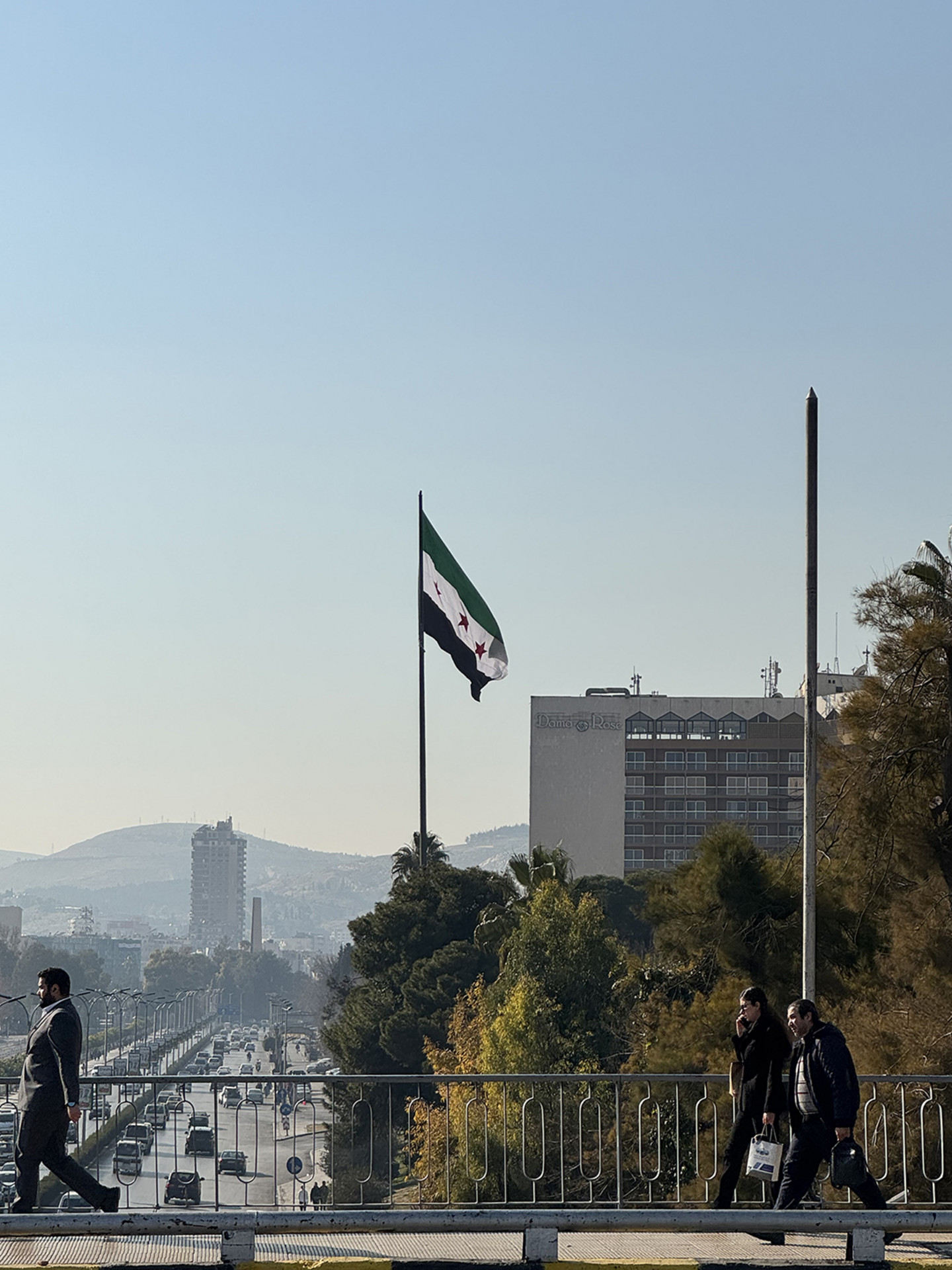
Following the overthrow of Bashar al-Assad’s regime, the new interim government is presented with a unique opportunity to establish good governance. However, ensuring security, stabilizing and revitalizing the economy, and building political cohesion pose enormous challenges. How the interim government copes with these challenges will be decisive for its legitimacy.
Transitional justice is another key challenge, and this includes confronting past mass atrocities and gross human rights violations by ensuring accountability and by working towards reconciliation. Without an inclusive, meaningful transition, Syria risks falling back into a circle of violence and injustice.
‘Syria in Transition’ is meant to provide insights into and to discuss the current situation in Syria, the challenges it faces, and the prospects for a sustainable and peaceful future.
This SALON event is organized in cooperation with the Institute for International Peace and Security Law and the Cologne Center for Advanced Studies in International History and Law (CHL).
This SALON event is fully booked. Please follow us on Instagram to stay tuned on last minute vacancies.
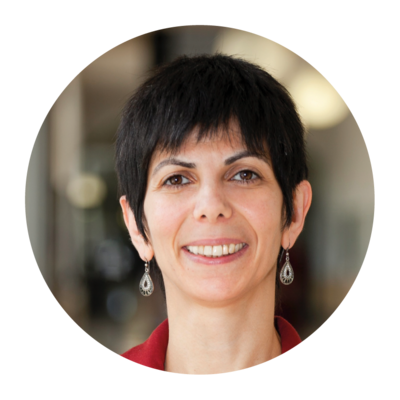
Anan Alsheikh Haidar is a Research Fellow at the Institute for International Peace and Security Law at the University of Cologne. Previously, she served as a Phillipp Schwartz Fellow at the institute from July 2016 to December 2018. Dr. Haidar holds a Ph.D. in Law from the University of Reading where she also completed her Master of Laws (L.L.M) in Advanced Legal Studies, as a Chevening Scholar. Her legal education began at the University of Damascus, Syria, where she obtained Diploma in Law. Throughout her academic career, she focused on international criminal law and international human rights law.
Dr. Haidar is a member of the Cologne Center for Advanced Studies in International History and Law.
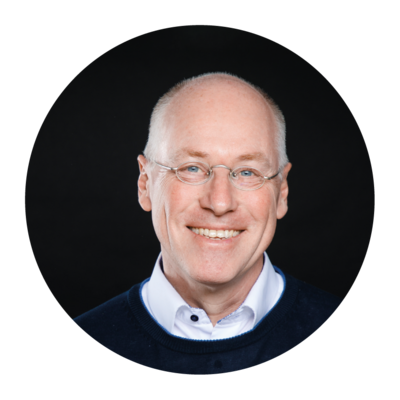
Claus Kreß
Claus Kreß has been Professor of Criminal Law and International Law at the University of Cologne since 2004. He holds the Chair of German and International Criminal Law and is Director of the Institute for International Peace and Security Law. Professor Kreß is also a founding member of the Cologne Center for Advanced Studies in International History and Law (CHL).
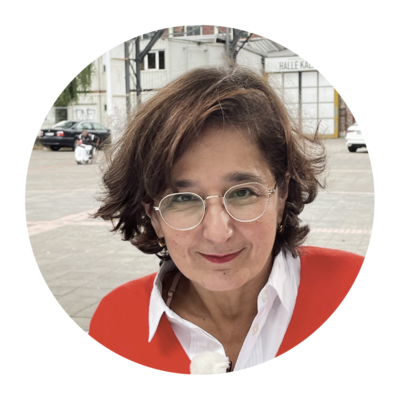
Isabel Schayani
Isabel Schayani is a journalist and broadcaster specializing in political and social issues. Since 2016, she has been responsible for the WDRforyou project, which is designed for refugees and is presented in four languages. Isabel Schayani is known for her precise analysis and committed reporting, especially on migration, integration and international crises. She has received several awards for her journalistic work, including the Grimme Prize.
In cooperation with: ZADIK (Zentralarchiv für deutsche und internationale Kunstmarktforschung)
Special Event in collaboration with ZADIK: Art and Cultural Goods in Circulation
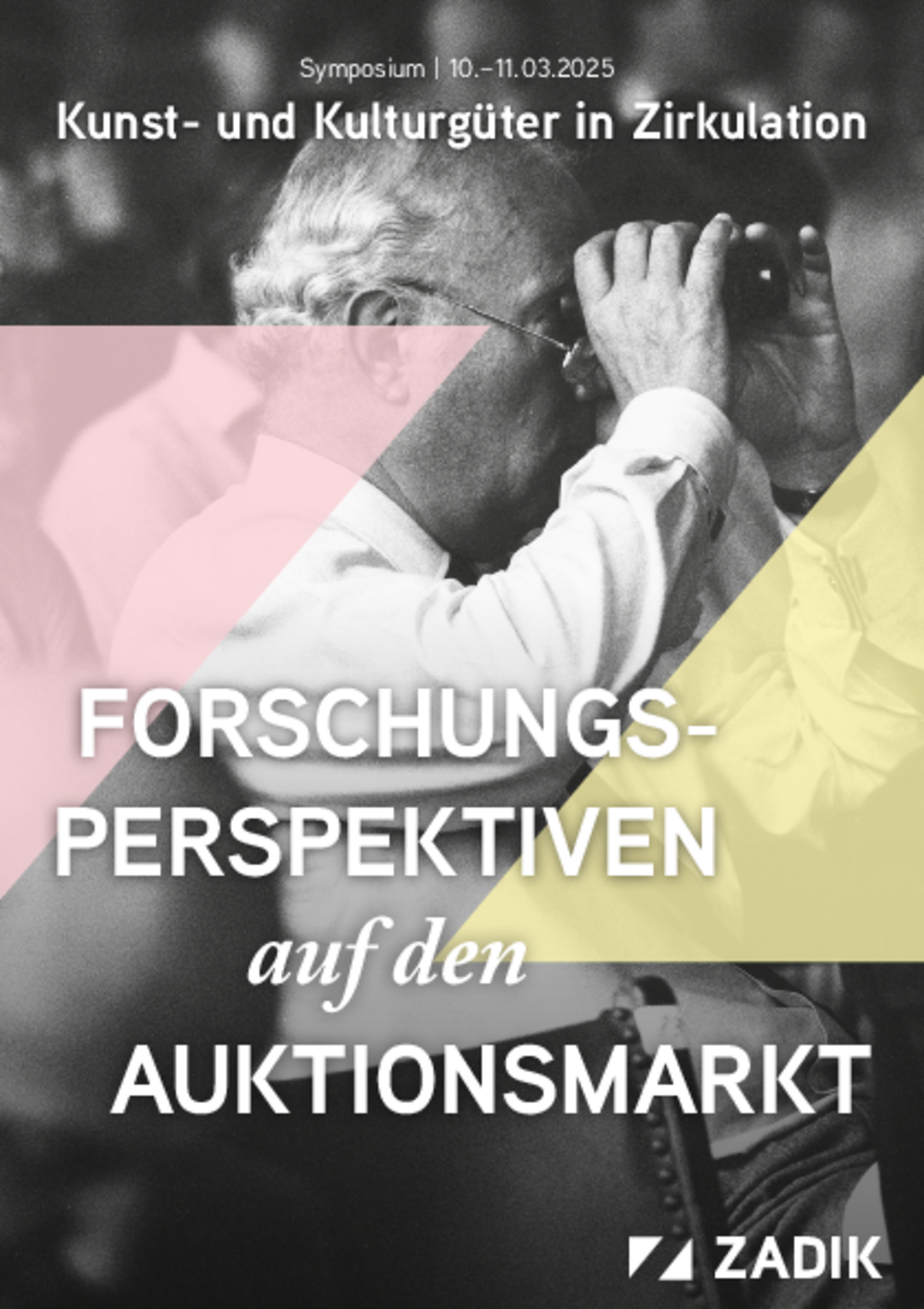
10-11 March, International House (Kringsweg 6)
Business records of auction houses are rarely accessible to the public but offer unique research data - especially for private sales, where they often represent the only sources for changes of ownership. This symposium focuses on the Hauswedell & Nolte archive, the first German auction house archive made publicly accessible. The event, and especially the podium discussion at the evening of 10 March, is open to the public.
SALON: HUMBOLDT LECTURE
Mulu Hundera
»Family Support in Female Entrepreneurship: Perspectives from a Developing Country«
29 January 2025 - 6 p.m., International House (Kringsweg 6)
The venue is wheelchair accessible and the lecture will be held in spoken English and translated into German sign language. Supported by the "Gebärdensprach- und Schriftdolmetschen" fund.
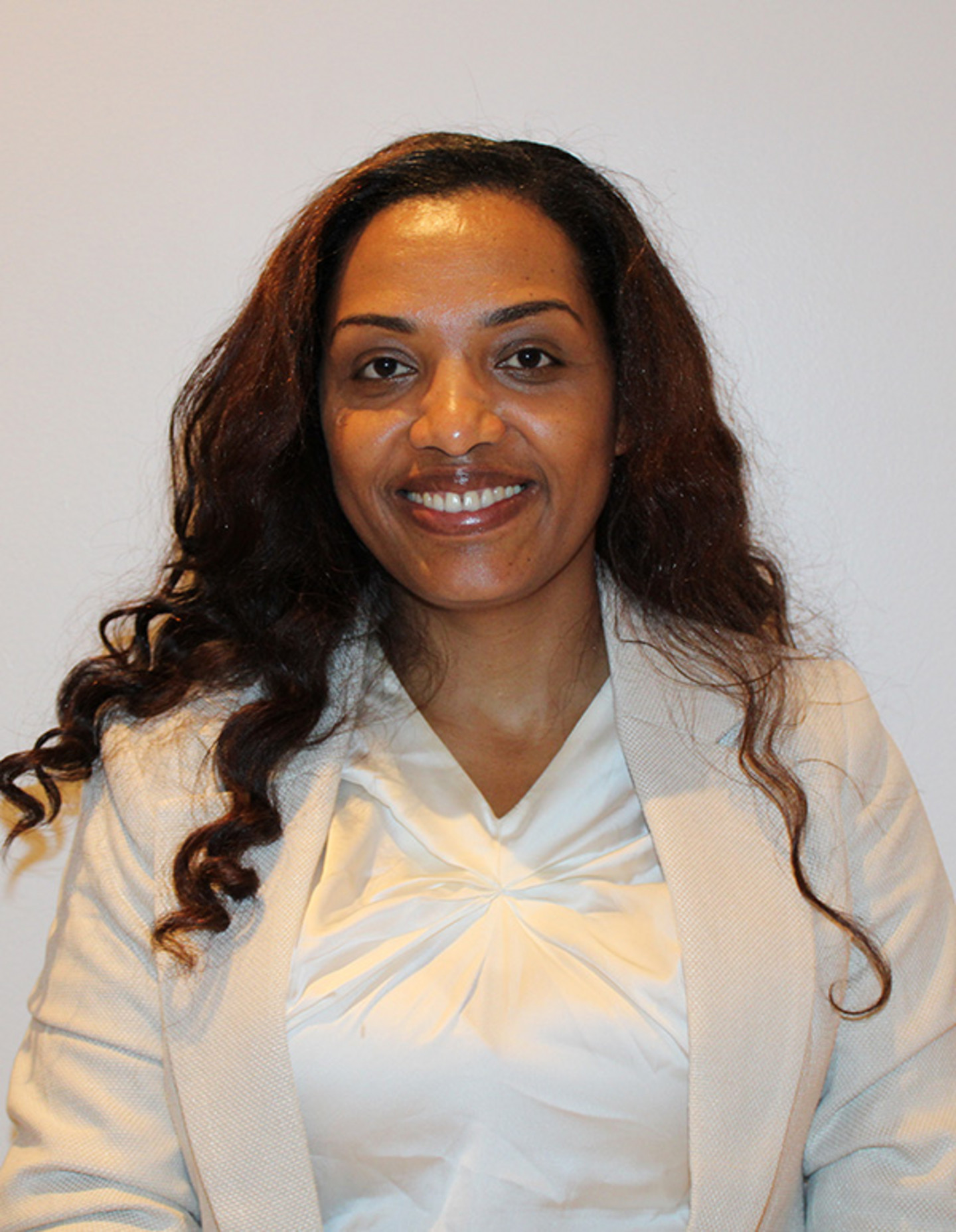
Dr. Mulu Berhanu Hundera, a scholar from Ethiopia focusing on entrepreneurship, strategic management, and gender studies. Currently a visiting postdoctoral scholar, her research focuses on female entrepreneurship in developing countries. Her expertise spans both academic research and practical fieldwork, having worked extensively at Haramaya University in Ethiopia and the Maastricht School of Management in the Netherlands.
In her talk, Mulu Hundera will let us gain insight into her study on the circumstances in which family support acts as both an enabler and a constraint on the success of female-led businesses in Ethiopia.
Her research enriches the knowledge on female entrepreneurship by reconciling research on family support and gender. It also extends the understanding of paradoxical relationships in entrepreneurship. The study emphasizes the importance of policy interventions to address traditional gender roles and optimizing family support.
We are looking forward to hearing more about the “family support paradox” and invite you to join us.
Cologne International Forum: Perspectives

Herausforderungen für die Demokratie in der postmigrantischen Gesellschaft
Die Ringvorlesung des Instituts für Sprachen und Kulturen der islamischen geprägten Welt (ISKIW) und des Instituts für Soziologie und Sozialpsychologie (ISS) der Universität zu Köln befasst sich mit Herausforderungen für die Demokratie in der postmigrantischen Gesellschaft angesichts der aktuellen politischen Entwicklungen. Dazu gehören Verletzungen von Menschenrechten und Ideologien der Ungleichheit, Autoritarismus in seinen verschiedenen Formen, Antisemitismus und antimuslimischer Rassismus.
Wir freuen uns die Januar-Veranstaltungen als Kooperationspartner am Cologne International Forum begrüßen zu dürfen.
Die Veranstaltungen im Januar finden im International House, Kringsweg 6 statt.
Eine Anmeldung ist erforderlich.
13.01.2025, 16:00-17:30 Uhr (hybrid)
Ozan Zakariya Keskinkılıç (Humboldt University Berlin):
Wie fühlt es sich an, als Gefahr wahrgenommen zu werden? Selbstbilder, Emotionen und Umgangsweisen mit dem „Bedrohungsszenario“ im antimuslimischen Rassismus
20.01.2025, 16:00-17:30 Uhr (NUR ONLINE)
Prof. Dr. Naika Foroutan (DeZIM, Berlin):
„Importierter Antisemitismus“? Herausforderungen für die postmigrantische Gesellschaft
27.01.2025, 16:00-17:30 Uhr (hybrid)
Prof. Dr. Claus Leggewie (em./KWI Essen):
Erweiterte Demokratie: Für ein Parlament der Dinge
In cooperation with: Multidisciplinary Environmental Studies in the Humanities (MESH)
A Covenant for the Earth: An Introduction to Islam and Ecology

3 December 2024 - 6 p.m., International House (Kringsweg 6)
Al-Mizan: A Covenant for the Earth, presents an Islamic outlook on the environment in a bid to strengthen local, regional, and international actions that combat climate change and other threats to the planet.
After Imam Saffet Abid Catovic’s presentation, who was part of the Scholars Team in the writing of Al-Mizan, we will follow up with a panel response by
Dr. Katajun Amirpur (Islamic Studies, UoC)
Dr. Laurel Kearns (Ecology, Society, and Religion, Drew University)
Dr. Carrie Dohe (MESH, UoC)
Final Conference of the International Research Cluster
Conflict-Induced Displacement and Socio-Economic Resilience: Learning from Neglected Conflicts in Cameroon and Myanmar
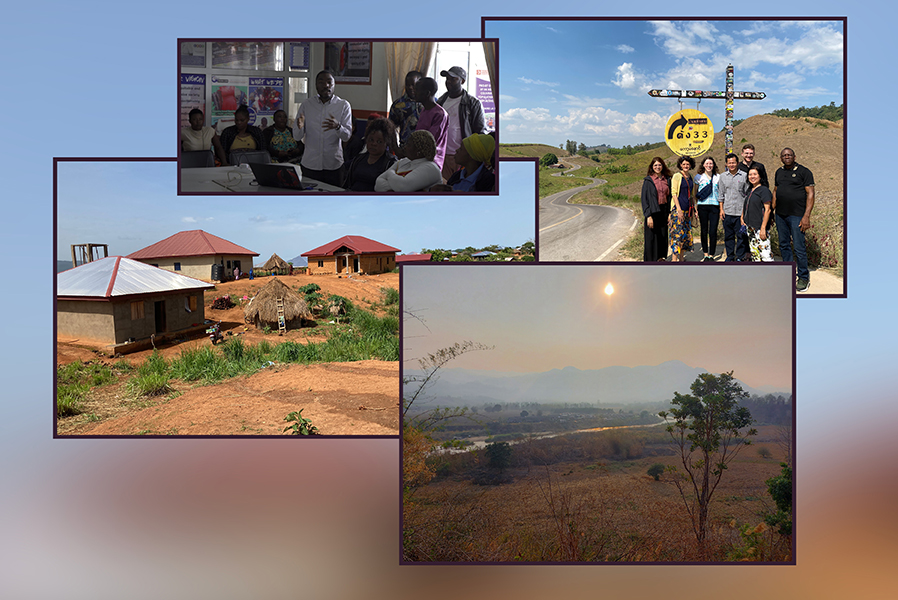
The currently estimated 281 million migrants worldwide constitute 3.6% of the global population (IOM 2022). Of these migrants, 89.5 million have been forcibly displaced (IOM 2022). This figure is larger than the domestic population of all but 16 countries in the world. Despite this overwhelming number of displaced persons, political and humanitarian measures to address forced migration are often ad-hoc and largely neglect the socio-economic aspects of this displacement. To better manage forced migration, it is important to understand migrants’ socio-economic situations, including their legal and economic integration in the host region as well as their economic contributions in the conflict zone. Research-based analyses and policy recommendations for developing resilient economic and livelihood systems will be an important academic contribution to handling conflict-induced migration and facilitating the achievement of the UN Sustainable Development Goals (SDGs).
The Directorship of the International Research Cluster for researchers at the University of Cologne is one of the funding opportunities of the Cologne International Forum. It enables the realization of up to 5 internationalization projects for comprehensive international, possibly also interdisciplinary networking within the framework of a central research focus. In 2023/24 Prof. Dr. Michaela Pelican has been Director of the cluster, which will now hold its concluding conference.
SALON: LESUNG UND GESPRÄCH
Charlotte Wiedemann
»Israel, Palästina, Deutschland: Traumata und Humanität«
26 November 2024 - 18 Uhr, International House (Kringsweg 6)
Der Veranstaltungsort ist rollstuhlgerecht. Der Vortrag findet in deutscher Lautsprache statt und wird in die Deutsche Gebärdensprache übersetzt. Unterstützt durch den Fond "Gebärdensprach- und Schriftdolmetschen".
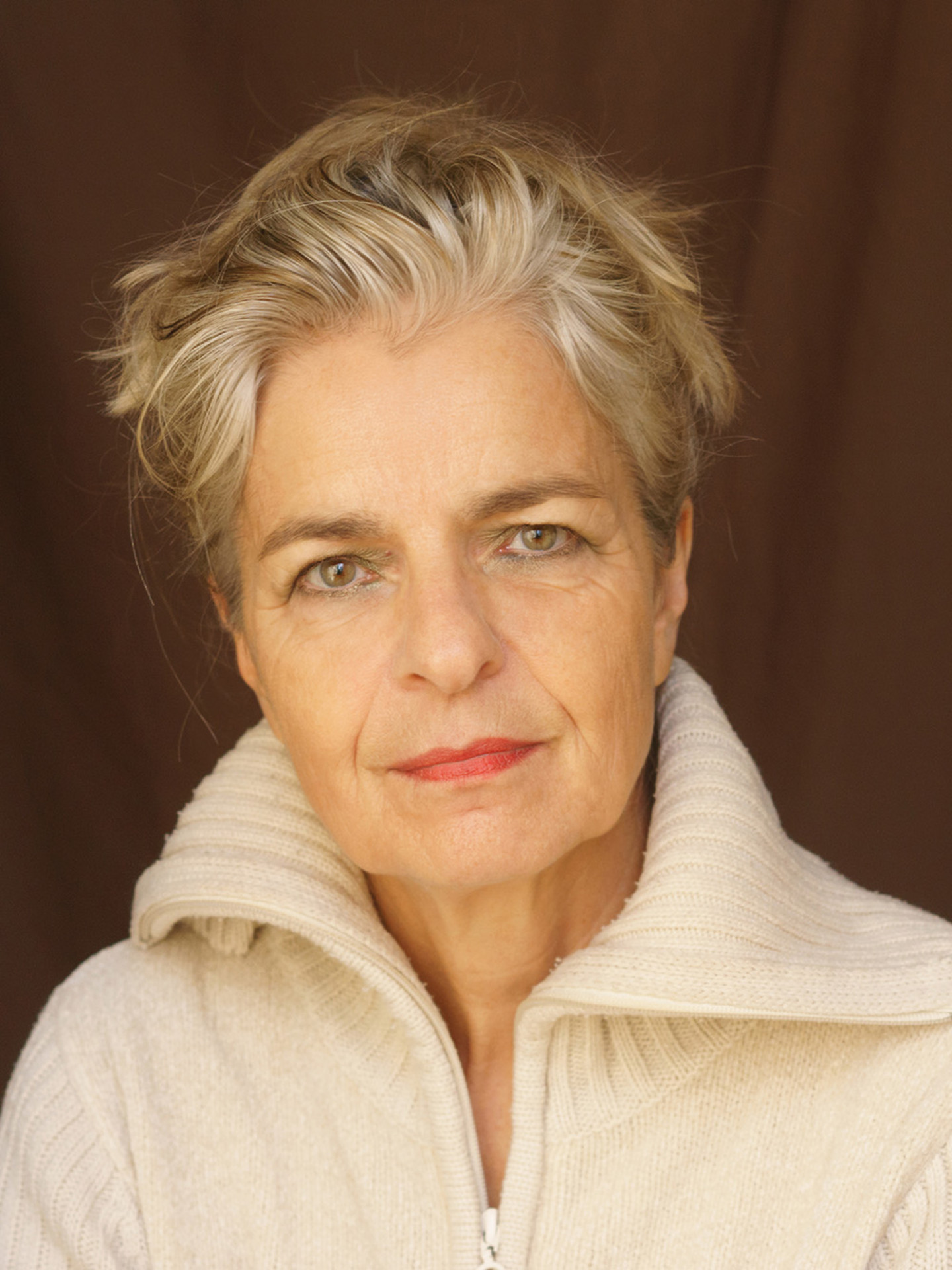
Was bedeutet historische Verantwortung?
Gibt es Alternativen zur „Staatsraison“?
Welche Rolle spielt die Anerkennung von Holocaust und Nakba in der Vision „A Land for All“?
Die Autorin Charlotte Wiedemann spricht mit Stephan Milich über ihre Erfahrungen in Israel und im Westjordanland und liest aus ihrem Buch „Den Schmerz der Anderen begreifen. Holocaust und Weltgedächtnis“.
SALON: CONVERSATION
Tahereh Aboofazeli, Arjang Omrani, Simone Pfeifer, Kris Rutten, Nanette Snoep, and Masoumeh Zolfaghari
»Weaving Memories - Doing Research with and for the People«
25 November 2024 - 6 p.m., International House (Kringsweg 6)
The venue is wheelchair accessible and the lecture will be held in spoken English.
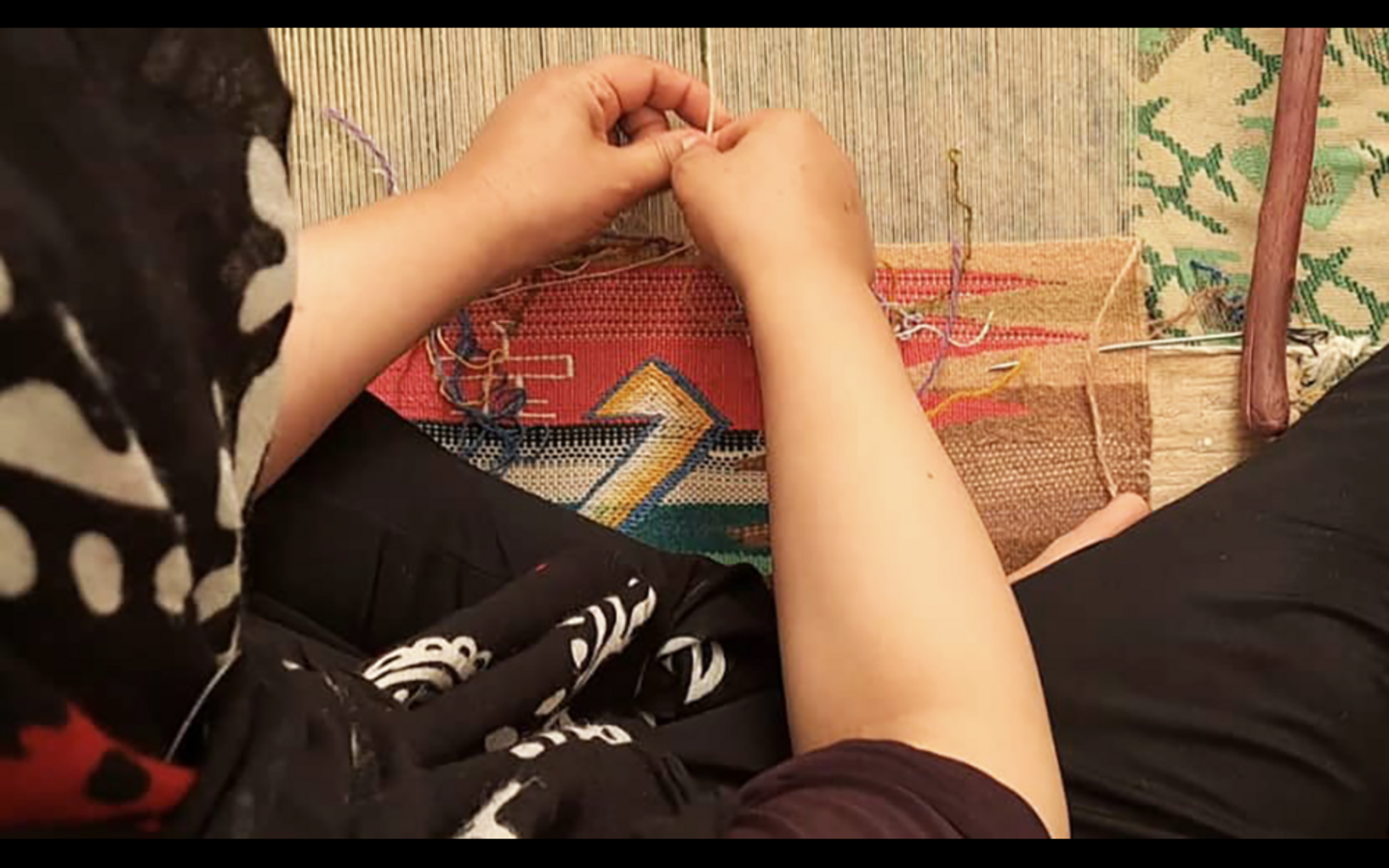
In this public event we present and discuss the joint exhibition by artist-weavers and researchers from Iran and Germany, “WE ARE NOT CARPETS – I Tell You My Story.” The collaborative exhibition is shown at the Rautenstrauch-Joest Museum and presents newly created, unique personal carpets and their stories, which are experienced in a poetic and cinematic way. The carpets are the result of the collaborative research project “Weaving Memories,” which provides weavers from the North Khorasan region in Iran with a platform to tell their stories by transforming their craft into a medium of storytelling and as works of art.
With Cologne Center for Advanced Studies in International History and Law (CHL)SALON: PODIUMSDISKUSSION
SALON: PODIUMSDISKUSSION
»Wissenschaftskommunikation oder politischer Aktivismus?
Public Outreach in der historischen Friedens- und Konfliktforschung«
22 November 2024 - 18 Uhr, International House (Kringsweg 6)
Der Veranstaltungsort ist rollstuhlgerecht und der Vortrag findet in deutscher Lautsprache statt.
- Prof. Dr. Eckart Conze, Universität Marburg
- Dr. Franziska Davies, Ludwig-Maximilians-Universität München
- Prof. Dr. Felix Lange, Universität zu Köln
- Prof. Dr. Tatjana Tönsmeyer, Universität Wuppertal
- Dr. Arvid Schors, Universität zu Köln (Moderation)
Das Verhältnis von akademischer Geschichtswissenschaft und breiterer Öffentlichkeit ist seit jeher von gewissen Spannungen geprägt. Während Historiker*innen ihre Forschungsergebnisse gewöhnlich in Büchern festhalten, ist in der Medienöffentlichkeit die pointierte Stellungnahme gefragt. Die moderierte Podiumsdiskussion zwischen vier Wissenschaftler*innen, die regelmäßig Medienanfragen zu für die historische Friedens- und Konfliktforschung relevanten Themen erhalten, zielt darauf ab, die Außenwirkung dieser Forschung kritisch zu debattieren.
Dabei soll grundsätzlich die Frage erörtert werden, in welchem Verhältnis Wissenschaftskommunikation einerseits und politische Positionierungen andererseits zueinanderstehen und wo die Grenzen zwischen diesen Sphären verlaufen – insbesondere bei den häufig mit hohem Polarisierungspotenzial einhergehenden Themen der Historischen Friedens- und Konfliktforschung.
SALON: LECTURE
Natasha A. Kelly
»Black Studies – Vergangenheit, Gegenwart und Zukunft«
30 October 2024 - 18 Uhr
Der Veranstaltungsort ist rollstuhlgerecht. Der Vortrag findet in deutscher Lautsprache statt und wird in die Deutsche Gebärdensprache übersetzt. Unterstützt durch den Fond "Gebärdensprach- und Schriftdolmetschen".
Theorien, Konzepte und Methoden der Black Studies, wie Diversity, Intersectionality oder Critical Race Theory, haben bereits Einzug in deutsche Universitäten gehalten, dennoch steht die Institutionalisierung dieses akademischen Feldes noch aus. In ihrem Vortrag wird Prof. Dr. Natasha A. Kelly einen tiefen Einblick in die Geschichte, Gegenwart und Zukunft der Black Studies geben und die damit verbundenen Herausforderungen, Konflikte und Potenziale beleuchten. Von der Analyse der afrikanischen Diaspora bis zur Untersuchung von strukturellem und institutionellem Rassismus – dieser Vortrag bietet eine umfassende Einführung in ein wichtiges und dynamisches Feld der Wissensproduktion aus afrozentrischer Perspektive.

Natasha A. Kelly ist seit dem Wintersemester 2023 Gastprofessorin für Kulturwissenschaften im Studium Generale der Universität der Künste Berlin. Sie ist Kommunikationswissenschaftlerin und Soziologin, Autorin und Herausgeberin, Kuratorin und multimediale Künstlerin mit den Themenschwerpunkten Schwarze deutsche Geschichte, Schwarzer Feminismus und Afrofuturismus.
Concluding Event on 19 October 2024 – MESH, EUniWell, Bridges und Titel Autumn Academy for Planetary Wellbeing
Pop-Up Exhibition: Multispecies Storytelling
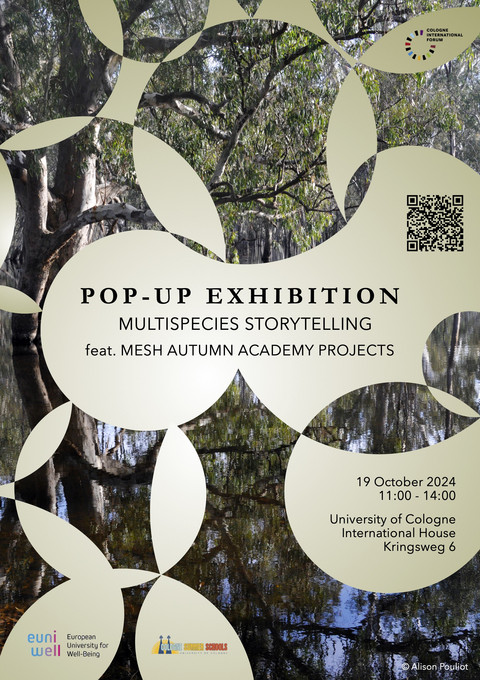
Pop-Up Exhibition on Multispecies Storytelling feat. participant projects at the University of Cologne, International House
The exhibition displayed the collective multimodal results of one week of intense multidisciplinary collaboration and exchange of our Autumn Academy participants on the topics of Multispecies Conviviality and Planetary (More-than-human) Wellbeing.
Further information:
mesh.uni-koeln.de/events
mesh.uni-koeln.de/events/meshworks

Lecture Series in German
Ringvorlesung: Rassismuskritik
The diversity of our (international) scholars enriches the research at the University of Cologne significantly. To achieve an atmosphere in which this diversity is fully appreciated and supported, we need continued discussions on discrimination and structural racism. The Cologne International Forum therefore supports the lecture series Rassismuskritik organized by the Institute of Languages and Cultures of the Islamic World.
Montags 16-17 Uhr, Hörsaal 121 (Gronewaldstr. 2)
Wir beschäftigen uns in dieser Ringvorlesung mit Rassismus in all seinen Variationen und Spielarten: Antisemitismus, anti-muslimischem Rassismus, anti-schwarzem Rassismus, Antiziganismus etc., strukturellem sowie institutionellem. Zu diesen Themen werden Angehörige der UzK, aber auch Gastdozierende von anderen Universitäten und Institutionen sprechen, um möglichst viele Aspekte abzudecken. So wird auch die Geschichte des Kolonialismus eine große Rolle spielen, des christlichen wie des islamischen. Eingehen wollen wir zudem auf Strategien gegen die heutigen, speziell in Deutschland vorhandenen Formen des Rassismus - und uns immer wieder diskutierten Fragen stellen, wie: Gibt es Rassismus gegen Weiße? Oder: Dürfen Nicht-Betroffene über Rassismus forschen/sprechen?
Aufgrund der hohen Nachfrage, kann die Teilnahme nicht garantiert werden. Wir bitten Studierende darum, sich ausschließlich über KLIPS anzumelden. Alle anderen melden sich bitte hier an.

LECTURE
Siavush Randjbar-Daemi
»The Power of Words - The Writer's Association in Iranian Politics«
5 July, 2024 — 6 p.m.

In his talk, Siavush Randjbar-Daemi explores the Kanun-e Nevisandegan-e Iran, a key writer‘s association, and its role in Iranian politics from 1968 to the 1979 revolution. It highlights how the association became the main non-
violent dissident group during a time of heavy political re-pression, uniting major intellectual figures who had been divided by political conflicts. As part of his upcoming study, Randjbar-Daemi presents a new perspective on the Iranian revolution beyond the usual focus on religious leaders.
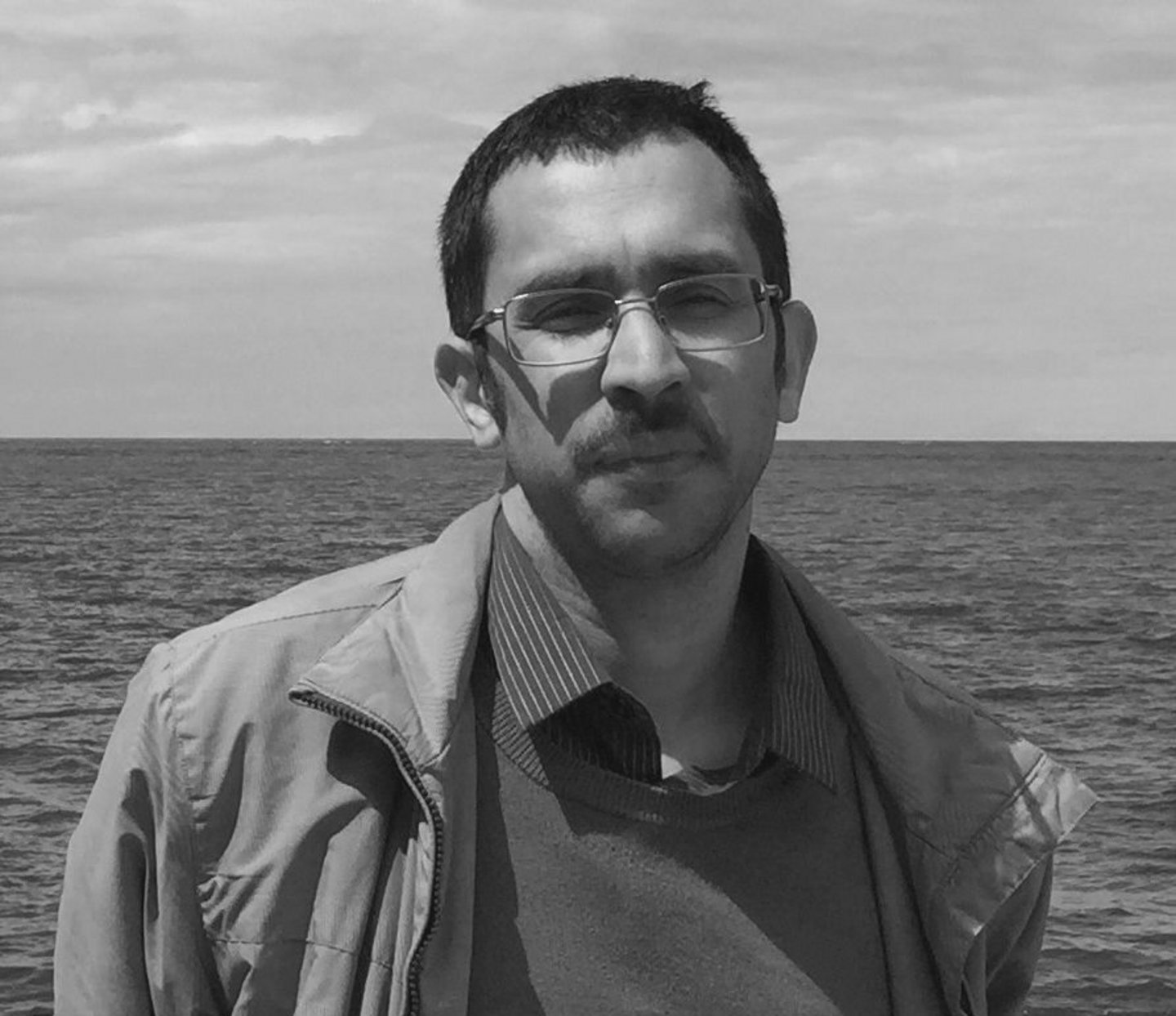
Siavush Randjbar-Daemi is a Lecturer (Assistant Professor) in Modern Middle Eastern History at the University of St Andrews. His core research interests lie in the evolution of the state in modern and contemporary Iran, and the contribution to the public sphere, particularly in periods of relative pluralism, such as the early 1950s or 1979-1981, of a variety of actors, from crowds formed by subaltern parts of society to socio-political elites.
LECTURE
Mert Kocak
»Constructing the Deserving Refugee: EU Financial Aid to Turkey and Refugee Governance «
27 June, 2024 — 6 p.m.
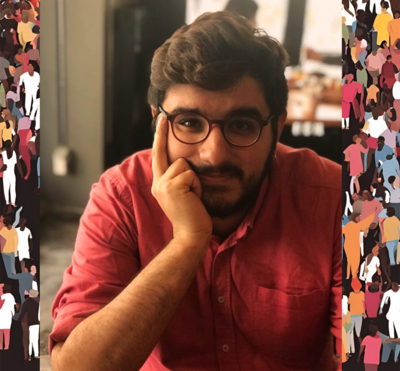
During his multi-sited fieldwork with LGBTI+ asylum seekers and refugees, and the local and transnational organizations in Turkey, Mert Kocak made a consistently recurring observation: asylum seekers and refugees gain access to certain rights not because they are entitled to them under national and international laws, but because bureaucratic bodies deem them deserving of these rights.
In this talk, we will seek to answer the following questions: What constitutes the discourse of deserving asylum seekers and refugees? What local and transnational actors play a role in constructing this discourse? How does the 2016 EU-Turkey Agreement influence it? And finally, how does deservingness affect the daily lives of refugees and asylum seekers?
LECTURE
Nira Liberman
»Can Poor Access to Internal States Explain Obsessive-Compulsive Tendencies?«
13 June, 2024 — 6 p.m.
Some people easily know what they feel, what they like and what they want. Others, however, find it difficult to access such internal states. Together with Nira Libermann we will look at obsessive-compulsive disorder (OCD) as an example of this difficulty. Instead of reflecting on their inner emotions, people with OCD rely on external signs that are easier to recognize, such as strict rules or repetitive behaviorisms. Studies have shown that people with OCD often misinterpret signals from their bodies, struggle to understand their emotions, and have a distorted sense of control over their actions. This approach helps us to discuss and understand why people with OCD often have compulsive habits, persistent worries, and doubts.
FILM SCREENING
Dan Smyer Yü & Franz Krause & Kate Rigby:
»Human Kinship with Nature in the Tibetan Plateau«
Rescheduled to May 14, 2024 — 6 p.m.


Ensouling the Mountain, directed by Dan Smyer Yü, chronicles a pilgrimage to Mt. Amne Machen (Amne Machin) in Qinghai Province, China, a sacred site for Tibetan communities. The film explores how the mountain embodies concepts of home, belonging, and the harmonization of nature. Pilgrims reflect on the significance of Amne Machen as a repository of collective memories, discussing themes of place-making and spirituality.
Dan Smyer Yü, an environmental anthropologist and scholar of religion and ecology, presents powerful insights into the cultural consciousness surrounding the mountain. His work delves into the intersection of landscape, memory, and sustainability, offering a profound understanding of humanity's relationship with the environment.
LECTURE
Simon Becker & Su Myat Thwe & Javier Revilla Diez:
»Insights into Myanmar’s Conflict-Induced Displacement and Livelihoods Situations of Post-Coup Displaced Communities in Mae Sot«
23 April, 2024 — 6 p.m.
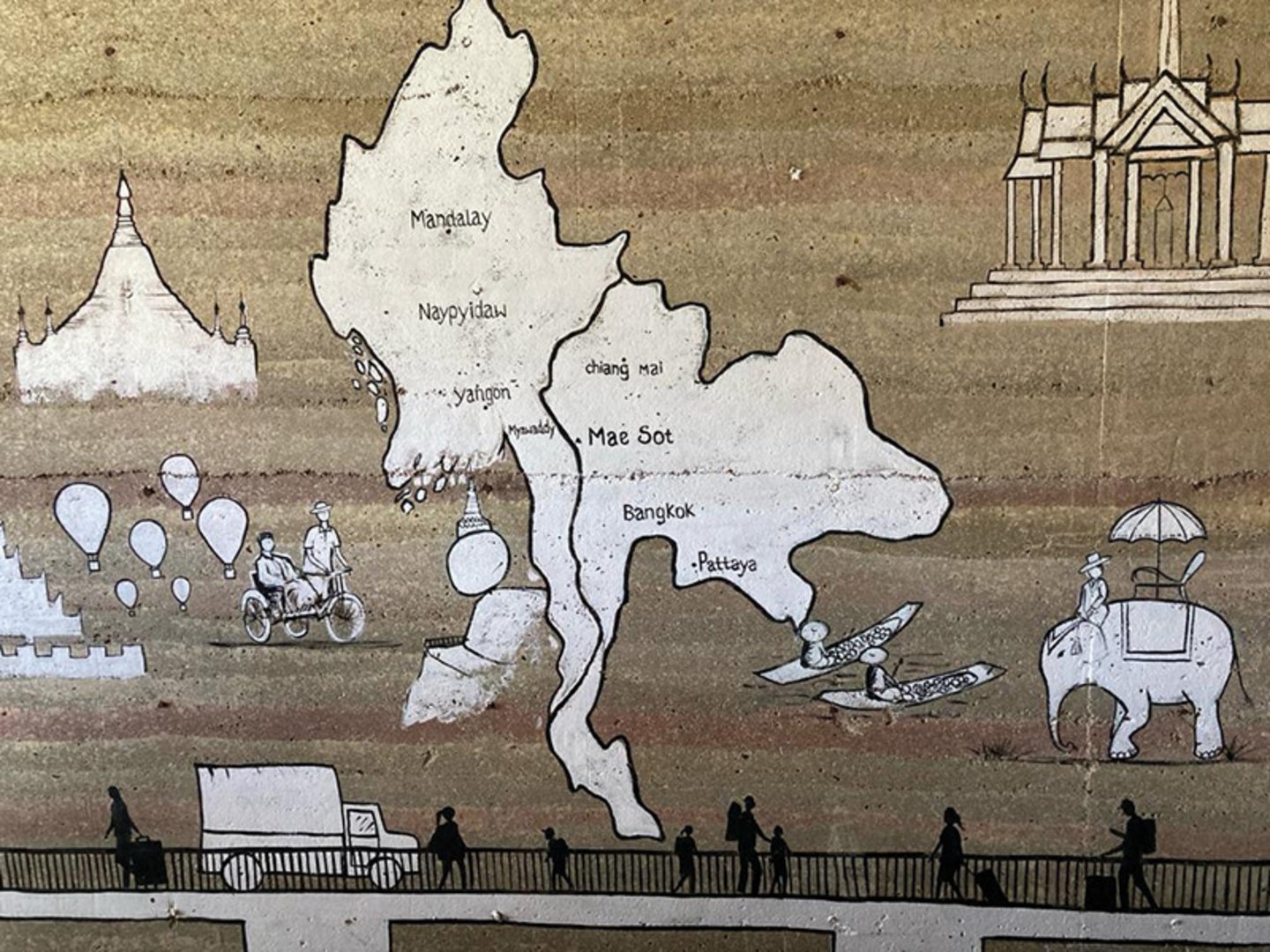
Since the 1948 declaration of independence, Myanmar has grappled with civil unrest, notably seen in the 2017 Rohingya exodus. The situation worsened after the 2021 coup, leading to increased violence and human rights violations, displacing approximately 2.4 million people by February 19, 2024.
This lecture will cover the current political climate in Myanmar, challenges faced by displaced individuals in Mae Sot, and their integration into the Thai labor market amidst demographic and economic constraints.
Presenters Su Myat Thwe and Simon Becker, members of the International Research Cluster “Conflict-Induced Displacement and Socio-Economic Resilience”, will share findings from their MA theses conducted at Chulalongkorn University, Bangkok, and the University of Cologne. The presentation will be followed by a moderated discussion and Q&A session.
Lecture Series
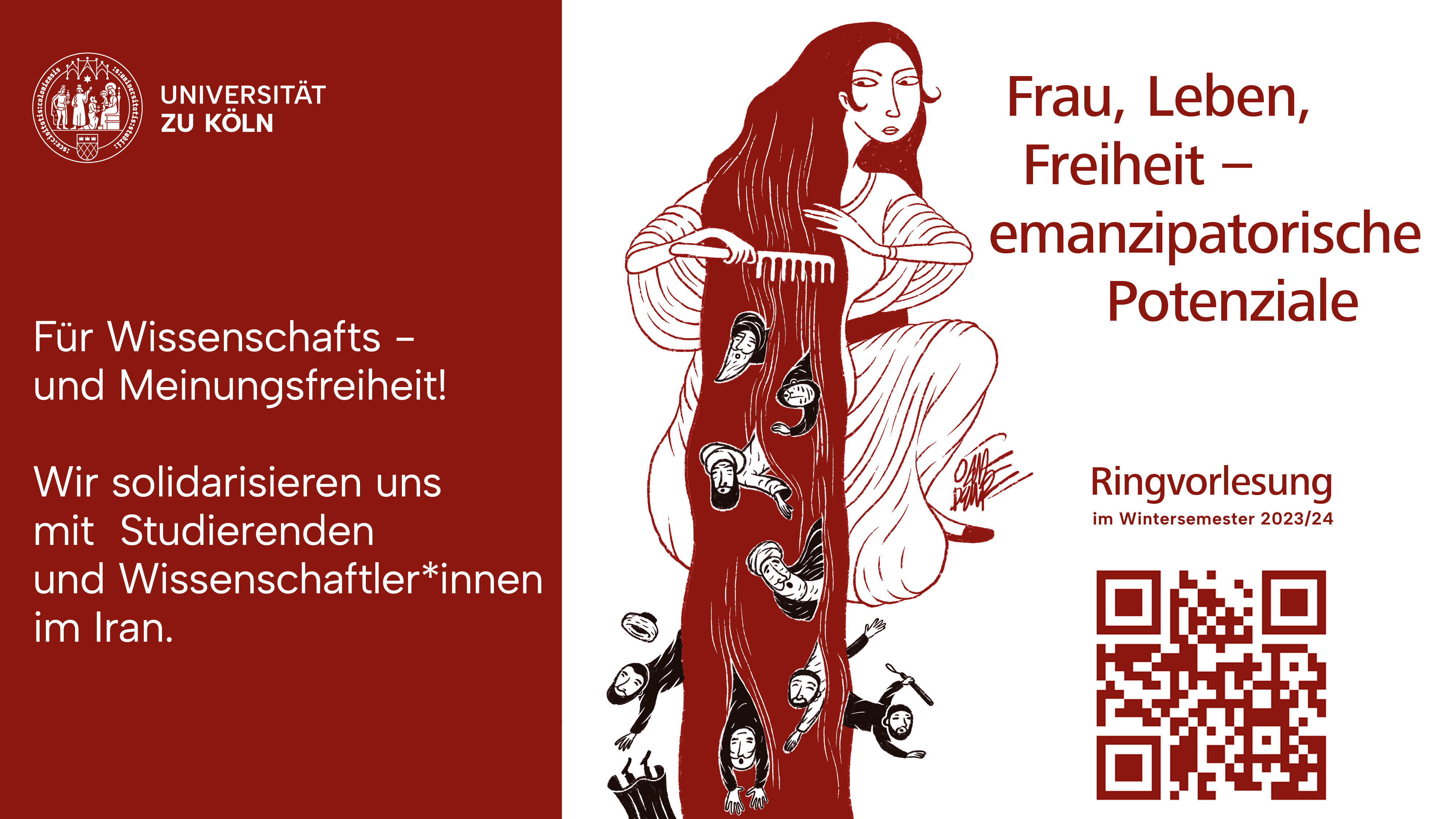
We are looking forward to supporting the second part of Professor Katajun Amirpur’s lecture series ‘Woman, Life, Freedom’ that will continue to shed light on the situation in Iran.
Knowing more about the political, historical, and cultural background of Iran and of course the current situation, will be crucial for academic collaborations – If they are to become possible on a larger scale.
The lectures will take place at the university or online and are open to the public. They will be held mostly in German.
LECTURE
Katajun Amirpur:
Women, Life, Freedom. What’s This All About?
23 January, 2024 at 6 p.m.
At our last SALON event for the winter semester of 2023/24, Prof. Katajun Amirpur will enrich our series with an insight into the struggle of the Iranian society. Prof. Amirpur will present her book “Iran without Islam – The Uprising against the theocracy” published in march 2023.
Women burn their hijabs, Mullahs have their turbans torn off their heads. Katajun Amirpur places the uprising against the theocracy, which has been underway since September 2022, into the context of a development that has so far barely been noticed by the West: not only the Iranian society is increasingly turning away from Islam, but also the regime itself. National greatness even publicly takes precedence over the Quran. It is not the Mullahs who rule, but the police and military forces. This stirring book allows us to see Iran with different eyes.
Katajun Amirpur has been Professor of Islamic Studies at the University of Cologne since 2018. She previously taught at the Universities of Hamburg and Zurich. Her research focuses on Shiite Islam, Iranian intellectual history, reform thinking in Islam and the theory and practice of gender movements.
LECTURE
Alice A. Salamena & Stephan Michael Schröder:
Fan Mail to Danish Film Stars in the 1910s
December 6, 2023 at 6 p.m.
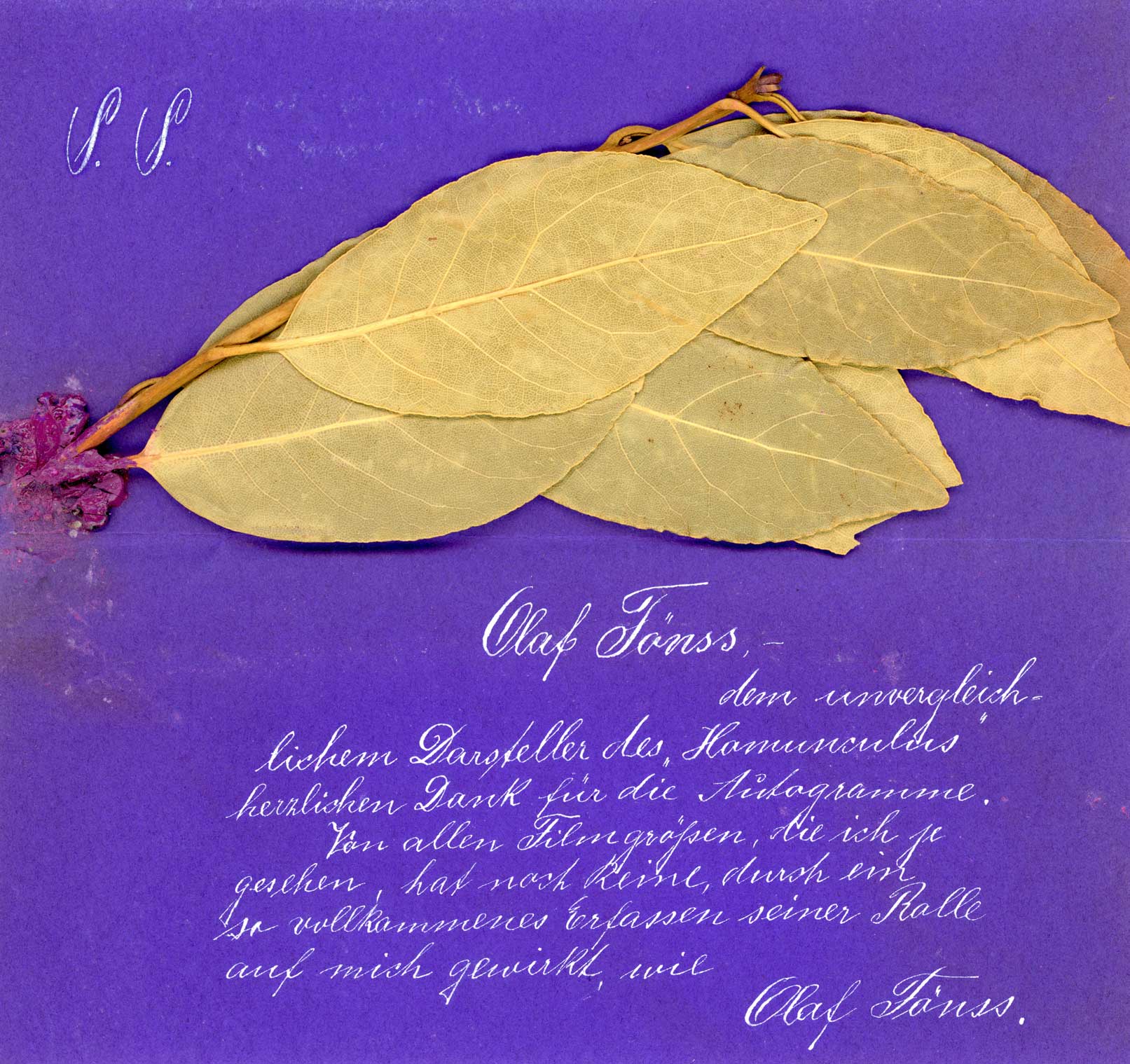
During the 1910s, the film fan came into being. But all we know about the establishment and formation of early film fan practices we know from heavily biased third-party accounts such as press articles, portrayals in literature and film or later memoirs of film stars. However, several newly discovered collections of fan mail to Danish film stars, totalling up to about 2,900 letters, not only makes it possible for the first time ever on a worldwide scale to reconstruct the agency and practices of early film fans and their sociological, cultural, gender and age diversity. At the same time, the difference to the media representation of ›the‹ fan and his/her fandom provides insights into the functionalization of the discourse on fans and fandom in the respective cultural, social and media-historical context.
LECTURE
Meltem Gürle: Resistance, Repetition, Retreat: Turkey and the Bildungsroman
We are happy to announce that Meltem Gürle will talk to us about the Turkish Bildungsroman on November 24, 2023 at 6 p.m.
Meltem Gürle is a comparative literature scholar whose focus is on the genre of the Bildungsroman, with a particular interest in the relationship of post-1950 twentieth-century Turkish literature to the modernist masterpieces of the West in the volatile context of recent Turkish political history. She was a Fritz Thyssen-Fellow at the University of Cologne until September and is presently working on her book, The Turkish Bildungsroman, in which she considers the Turkish influence on the development of the genre.
In this talk we look closely at the dialectical process involved in the formation of subjectivity within the Turkish Bildungsroman. The focus of this analysis centers on themes of stagnation, stasis, and trauma, which diverges notably from the conventional interpretation of the Bildungsroman genre as a narrative of reconciliation. Instead of focusing on the reconciliation of the individual with the society—the ultimate goal of the conventional Bildungsroman— our approach shifts its focus to the challenges encountered in the journey, which eventually evolve into patterns of resistance, repetition, and retreat.
Abstract
Meltem Gürle - Short Biography
Cologne International Forum: SALON
CONCERT
Gagaku - Traditional Japanese Music
Kölner Gagaku Ensemble — Monday, 6 November 2023, 6.30 p.m.
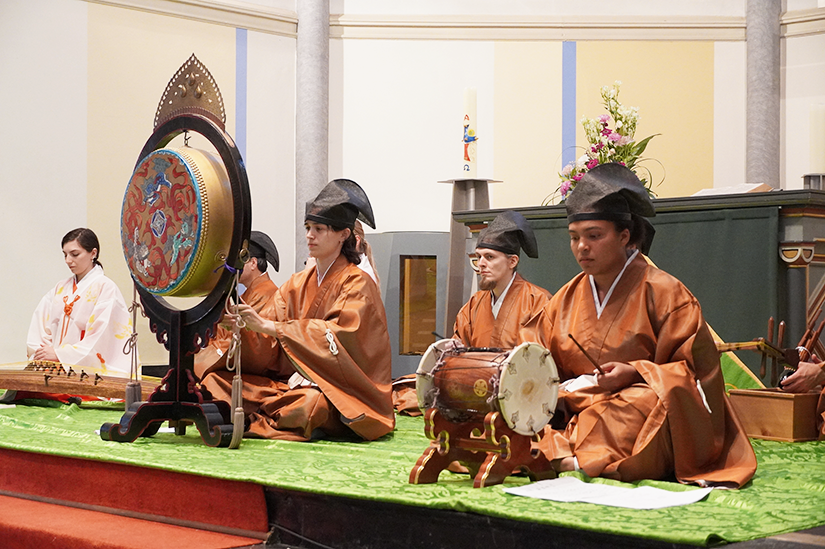
Gagaku, which means "elegant music" in Japanese, has been practiced since the 7th century, especially in the imperial court and in religious contexts. Originally, the music goes back to the ceremonial music of China and Korea. Japanese gagaku was designated an intangible cultural heritage by UNESCO in 2009. The highly traditional Japanese music has been "transplanted" to Cologne and cultivated in an experimental way since 2000 by the Cologne Gagaku Ensemble, which is the only gagaku group in Europe.
Since the beginning, the Cologne Gagaku Ensemble has been dedicated to perform traditional music and to contribute to the promotion of cultural understanding between Japan and Germany. The Tenri Japanisch-Deutsche Kulturwerkstatt e.V. Köln, a non-profit cultural association, has not only provided rehearsal space since 2006, but also all instruments of the ensemble. The director of the ensemble, Dr. Yoshiro Shimizu, is also a representative of Tenri University, a partner university of the University of Cologne.
The gagaku concert takes place on the occasion of the 60th anniversary of the city partnerships between Kyoto and Cologne.
We are looking forward to experiencing an important piece of Japanese culture within the SALON series of the Cologne International Forum.
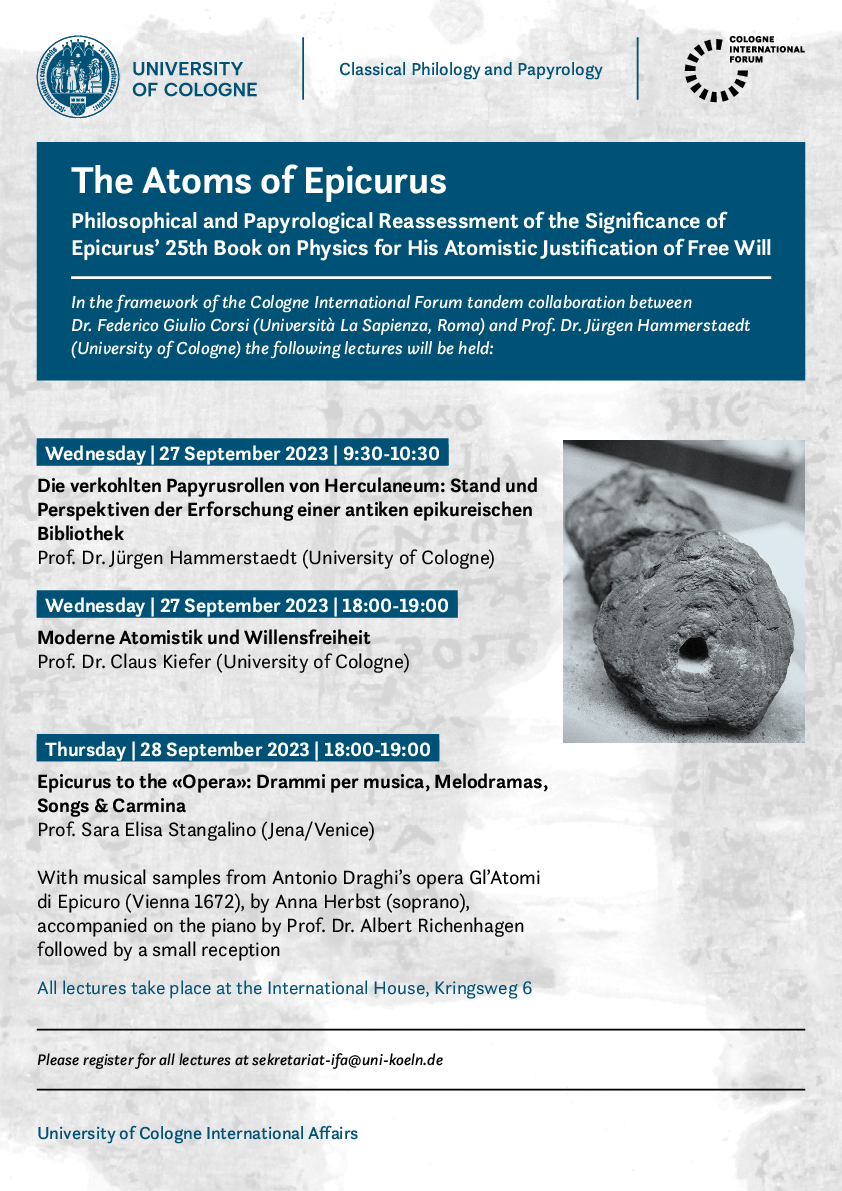
The Atoms of Epicurus
In the framework of the Cologne International Forum tandem collaboration between Federico Giulio Corsi (Università La Sapienza, Roma) und Jürgen Hammerstaedt (Universität zu Köln) three public events will be held at the International House on 26-27 September. Please have a look at the poster for further information.
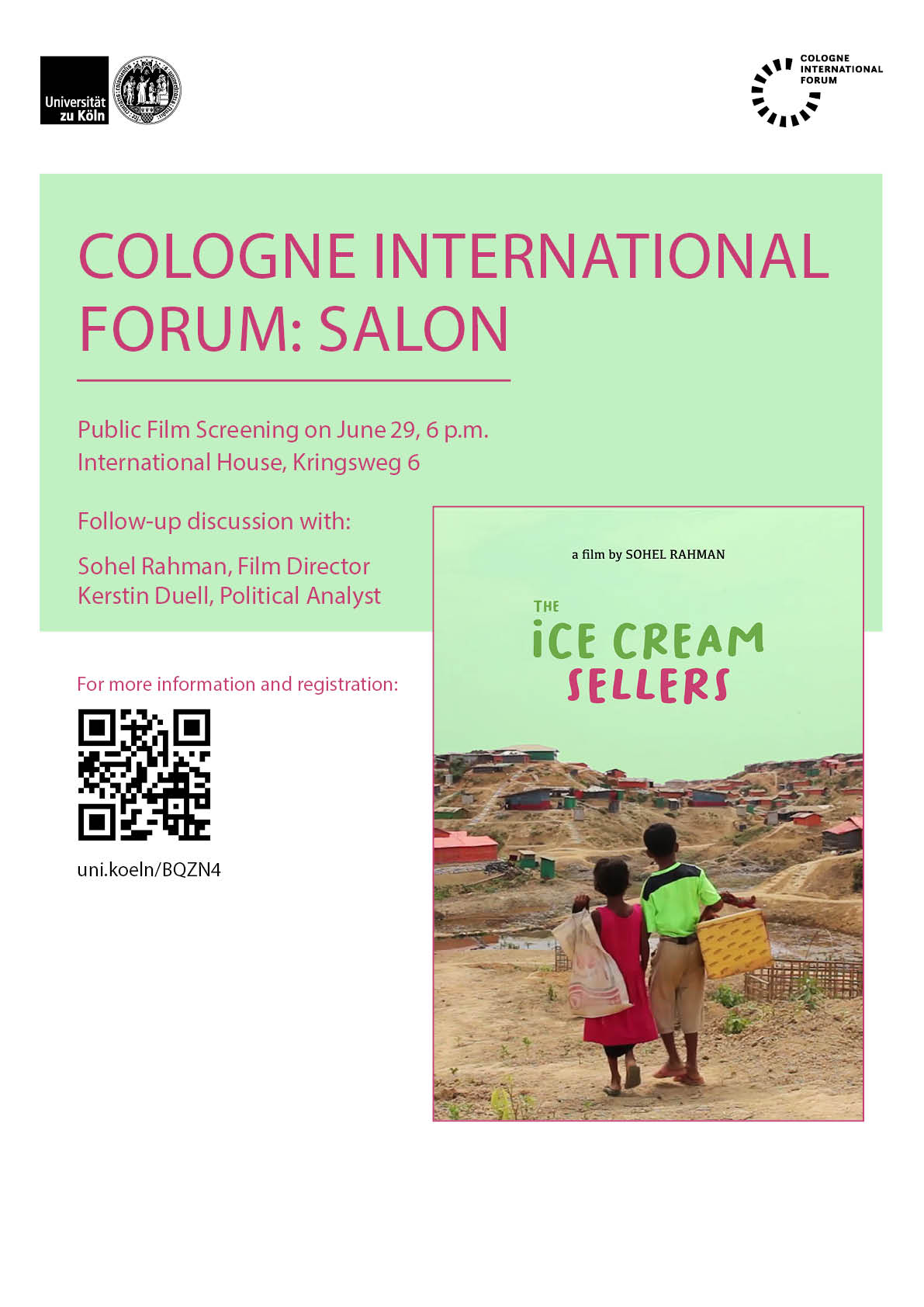
The Ice Cream Sellers by Sohel Rahmen
Film Screening - June 29, 6 p.m.
Kick-off Event of the Cologne International Forum Salon Series
The film The Ice Cream Sellers (2021, 75mn) is a human story of the Rohingya people - 'the most persecuted minority in the world. The film invites the audience to become a part of the journey of two young siblings Ayas (10) and Asia (8) across the refugee camp in Cox's Bazar, Bangladesh, just as the director himself was invited and received intimate access to their journey of life. The director takes the audience around the incredibly hot, dusty camp that stretches as far as the eye can see. The film portrays a story of tragedy and loss, courage, and suffering in the attempt by the two siblings to earn enough money to bribe officials for the release of their father from prison in Myanmar. The Ice Cream Sellers is a timely, relevant, and significant film, especially as it gives an insightful context to the Rohingya refugee community and their lives in Bangladesh, five years on from the onslaught of violence they experienced in August 2017.
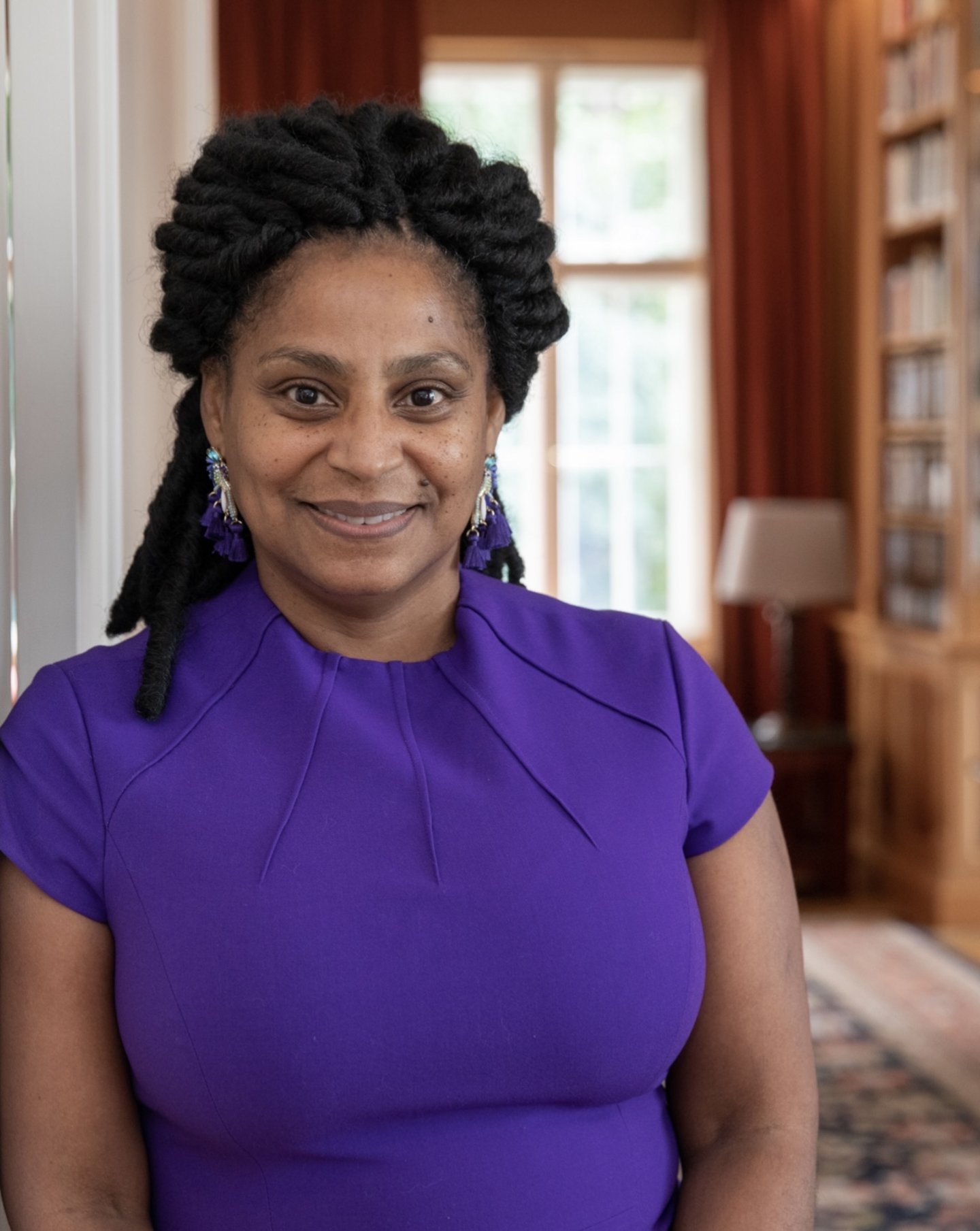
Cologne International Forum Opening:
»Classics Now: The Importance of Studying Antiquity in Our Present Age of Crisis«
Guest lecture by Jackie Murray (Professor of Classical Philology, University of Kentucky, SUNY Buffalo, Fellow of the American Academy, Berlin)

Cologne International Forum Overview